

Most packaging lines do not fail because they are too slow.
They fail because their timing windows become too narrow.
In many U.S. facilities, speed is treated as the primary solution. When output drops, operators increase RPM. When demand rises, management pushes acceleration.
But higher speed reduces tolerance.
When tolerance shrinks, instability grows.
What Is a Timing Window?
A timing window is the acceptable range in which one packaging machine transfers product to the next without disruption.
Every stage in packaging machinery operates inside a timing band:
- Conveyor transfers
- Filling index cycles
- Cap engagement points
- Label placement alignment
- Buffer release intervals
As long as spacing and synchronization remain inside that band, the system stays stable.
When variation exceeds it, errors begin.
Where the Assumption Breaks
The common belief is simple:
“If a packaging machine is rated for 140 bottles per minute, the line should run at 140.”
This ignores tolerance stacking across packaging machinery.
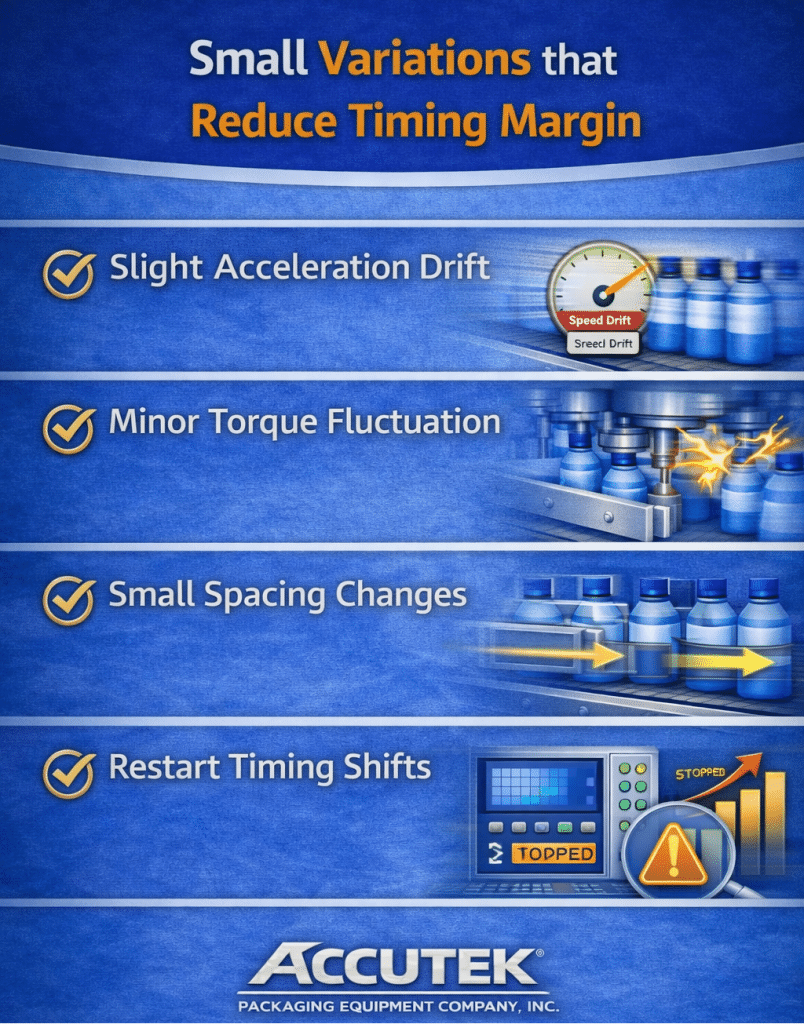
Each stage introduces small variation:
- Slight acceleration drift
- Minor torque fluctuation
- Small spacing changes
- Restart timing shifts
Individually, these variations seem minor.
Together, they compress the system’s timing window.
Machine Stage and Timing Tolerance
| Line Stage | Typical Timing Window | Risk When Margin Shrinks |
|---|---|---|
| Conveyor transfer | Spacing tolerance band | Container compression |
| Filling cycle | Index timing range | Fill variance |
| Capping engagement | Torque timing band | Reject increase |
| Label application | Alignment window | Cosmetic defects |
Each packaging machine depends on the previous one staying inside tolerance.
When one stage drifts, the next absorbs the error.
As speed increases, that margin narrows.
Speed and Window Compression
Higher speed reduces the time available for correction.
At elevated RPM:
- Containers arrive closer together
- Sensors react faster
- Mechanical engagement windows shorten
- Buffer absorption time decreases
This does not increase stability.
It reduces forgiveness.
Speed Increase and System Effect
| Speed Change | Window Effect | System Result |
|---|---|---|
| Moderate increase | Slight margin reduction | Manageable variation |
| Aggressive acceleration | Significant window shrink | Compression shock |
| High RPM with variability | Minimal tolerance band | Frequent micro-stops |
| Coordinated speed profile | Preserved margin | Sustained throughput |
When packaging machinery operates at high speed without coordination, small disturbances expand quickly.
Designing for Tolerance Instead of Maximum RPM
Throughput stability depends on preserving timing margin across packaging machinery.
Engineering for tolerance requires:
- Matched acceleration curves
- Coordinated restart logic
- Controlled buffer release
- Stabilized torque ramp engagement
Accutek Packaging Equipment designs integrated systems so each packaging machine follows a synchronized speed profile. When packaging machinery is engineered as a unified system, timing windows remain stable even as production rates increase.
Integration protects tolerance.
Tolerance protects throughput.
Control Strategy and Margin Protection
| Design Strategy | Effect on Timing Window | Throughput Impact |
|---|---|---|
| Independent machine tuning | Uneven tolerance | Oscillation risk |
| Excess buffer length alone | Delayed instability | Temporary relief |
| Coordinated control architecture | Stable margin band | Predictable output |
| Matched mechanical rhythm | Wider tolerance window | Sustained stability |
A packaging machine can perform well in isolation.
Packaging machinery performs best when timing windows are protected collectively.
The Hidden Cost of Narrow Timing Windows
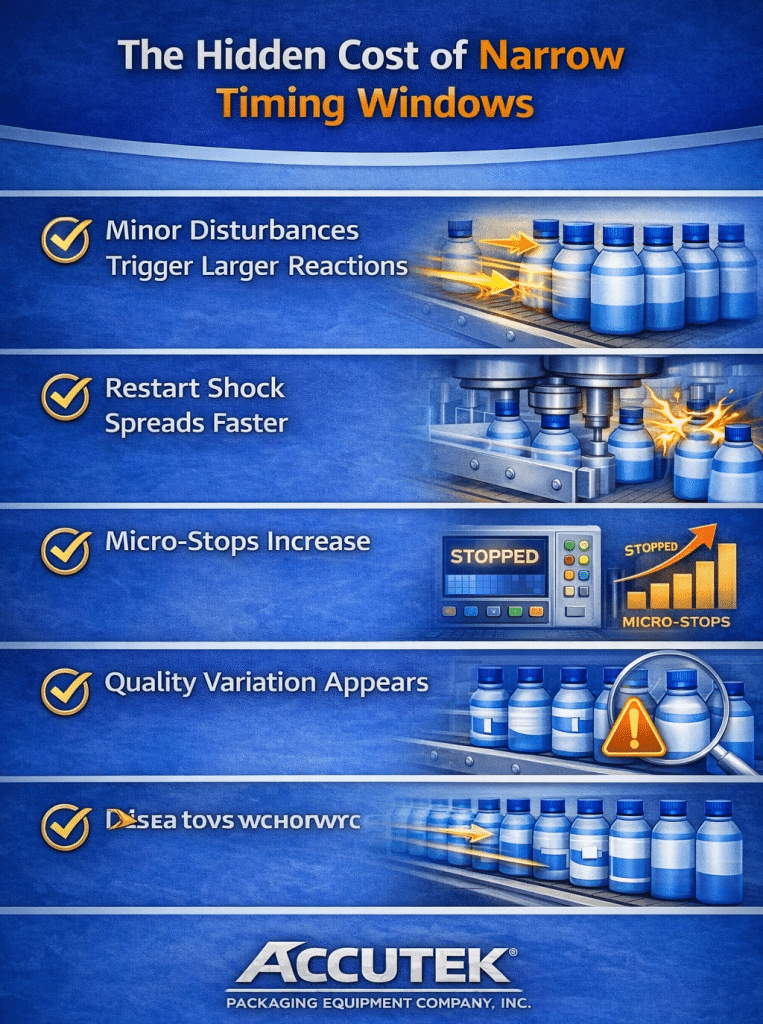
When timing margins shrink:
- Minor disturbances trigger larger reactions
- Restart shock spreads faster
- Micro-stops increase
- Quality variation appears
- OEE performance declines
These losses rarely appear as one major failure.
They emerge as gradual instability.
Explaining It Clearly
Imagine merging onto a highway.
If vehicles are spaced widely, merging is smooth. If spacing is tight, even a small speed change causes braking waves.
Packaging lines operate the same way.
Timing windows are spacing margins.
The tighter the spacing, the less forgiving the system becomes.
Why This Matters in the United States
U.S. manufacturers face:
- High labor cost
- Strict regulatory standards
- Frequent SKU changes
- Tight delivery schedules
Stable packaging machinery reduces:
- Corrective stops
- Rejects
- Operator intervention
- Schedule volatility
Throughput improves when tolerance is engineered, not compressed
Final Perspective
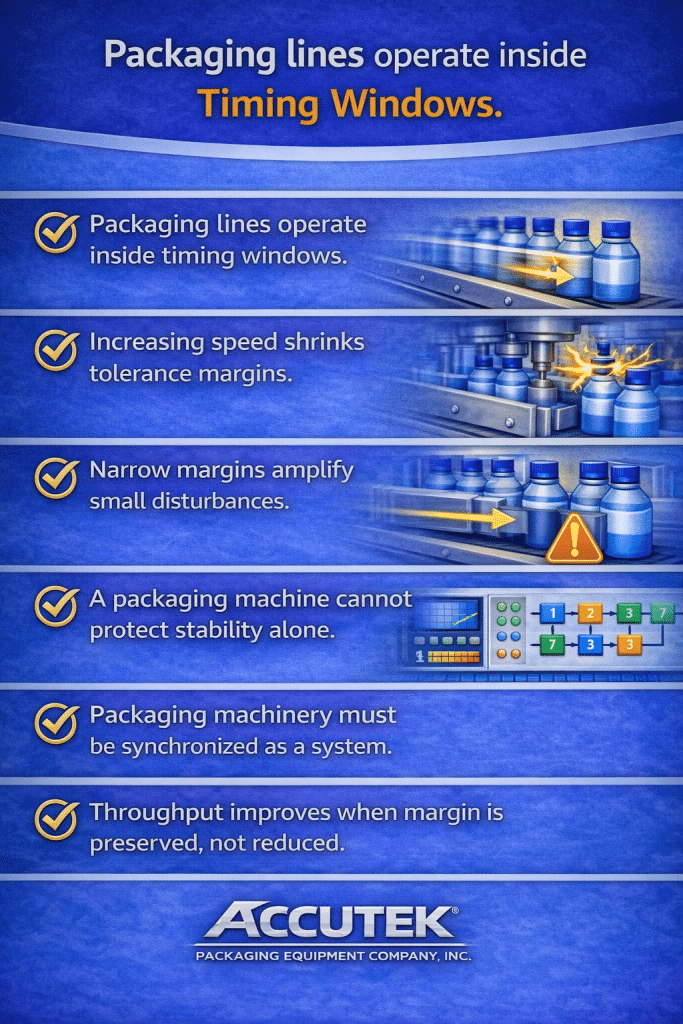
- Lines operate inside timing windows.
- Increasing speed shrinks tolerance margins.
- Narrow margins amplify small disturbances.
- A machine cannot protect stability alone.
- Packaging machinery must be synchronized as a system.
- Throughput improves when margin is preserved, not reduced.
For more details contact us:
| California | Texas | Florida |
|---|---|---|
| Address: 2980 Scott St, Vista, CA 92081 | Address: 8051 Jetstar Dr #175, Irving, TX 75063 | Address: 14231 Jetport Loop W #1, Fort Myers, FL 33913 |
| Phone: (760) 734-4177 | Phone: (972) 915-6888 | Phone: (239) 225-4020 |
| Fax: (760) 734-4188 | Fax: (971) 915-6999 | Fax: (239) 225-4024 |
| Hours: 8:00 AM – 4:30 PM | Hours: 8:00 AM – 4:30 PM | Hours: 8:00 AM – 4:30 PM |

