
In California manufacturing, speed sells.
Brochures highlight maximum output. Sales sheets emphasize peak RPM. Equipment is often selected based on the highest number printed on the page.
But in many California plants, instability does not come from under-capacity.
It comes from over-specification.
Bigger packaging machinery does not automatically create stable production. In fact, oversized systems often reduce control margin and increase performance variability.
The California Context
California manufacturers operate under unique pressures:
- High labor costs
- Strict food and pharmaceutical compliance
- Frequent SKU changes
- Limited production floor space
- Energy efficiency requirements
In this environment, sustained throughput matters more than peak capability.
A packaging machine rated for 300 bottles per minute may look impressive. If the facility only needs 140, that excess capacity can introduce mechanical imbalance.
Where the Assumption Breaks
The common belief is simple:
“Buying the largest packaging machine protects future growth.”
This ignores operating range behavior.
Every piece of packaging machinery has a designed performance band. When equipment runs far below its intended operating zone, control precision can degrade.
Oversized components often create:
- Reduced mechanical rhythm
- Inconsistent torque behavior
- Narrower effective timing windows
- Accumulation imbalance
The result is subtle oscillation.
Capacity vs Operating Stability
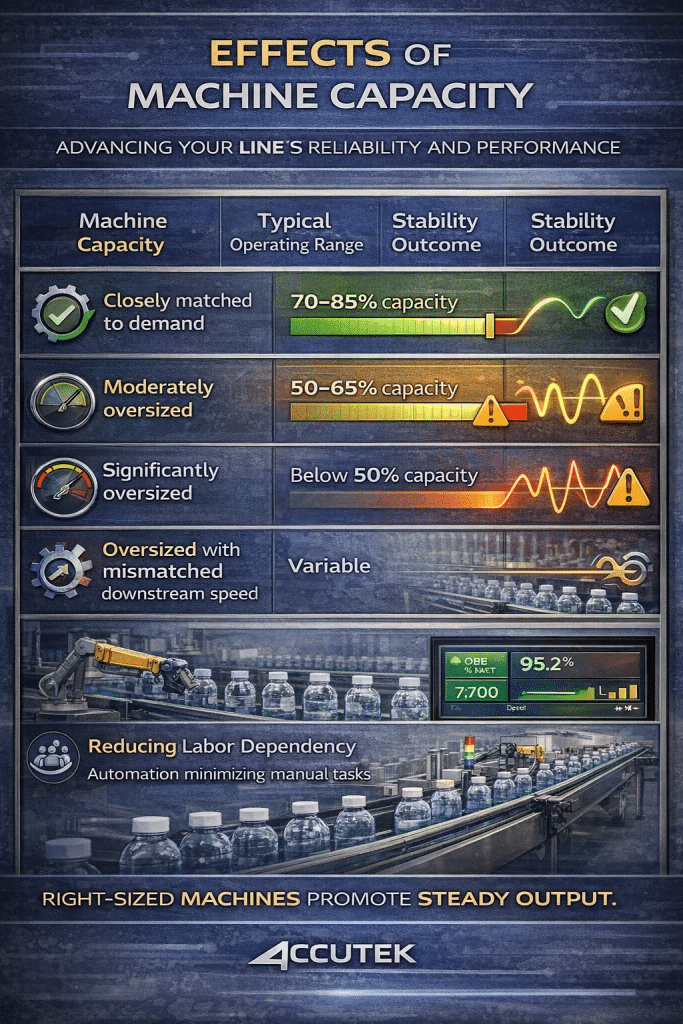
| Machine Capacity | Typical Operating Range | Stability Outcome |
|---|---|---|
| Closely matched to demand | 70–85% capacity | Stable rhythm |
| Moderately oversized | 50–65% capacity | Mild variability |
| Significantly oversized | Below 50% capacity | Oscillation risk |
| Oversized with mismatched downstream speed | Variable | Synchronization loss |
Equipment performs best when operating near its designed load band.
Running far below design range can reduce mechanical consistency.
The Hidden Risk of Partial Utilization
Oversized packaging machinery may require:
- Higher torque head inertia
- Larger drive assemblies
- Longer transfer distances
- Wider acceleration curves
When these systems operate at reduced speed, engagement timing can fluctuate.
For example, a high-speed rotary capper designed for aggressive torque engagement may produce inconsistent results when slowed significantly. The torque curve changes, which affects seal stability.
This does not show as a major fault.
It shows as performance drift.
Oversized Components and System Risk
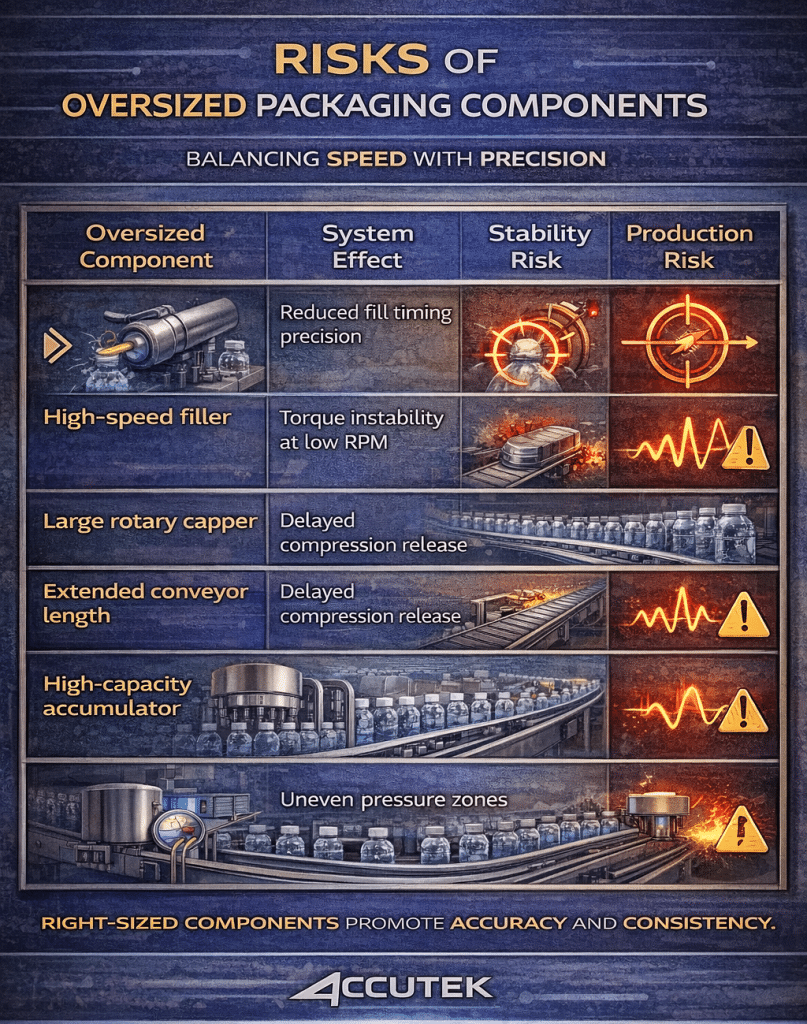
| Oversized Component | System Effect | Production Risk |
|---|---|---|
| High-speed filler | Reduced fill timing precision | Weight variation |
| Large rotary capper | Torque instability at low RPM | Seal inconsistency |
| Extended conveyor length | Delayed compression release | Flow oscillation |
| High-capacity accumulator | Uneven pressure zones | Restart shock |
Oversizing increases complexity without always improving output.
In California facilities where compliance matters, stability is often more valuable than raw speed.
Why California Facilities Feel This More
California manufacturers frequently handle:
- Short production runs
- Seasonal product shifts
- Organic and specialty goods
- Label and regulatory variation
In these environments, flexibility and rhythm matter more than maximum capacity.
Packaging machinery operating in the correct design band responds more predictably to SKU changes.
Oversized packaging machinery may amplify small disturbances during frequent transitions.
Right-Sizing Strategy for Stability
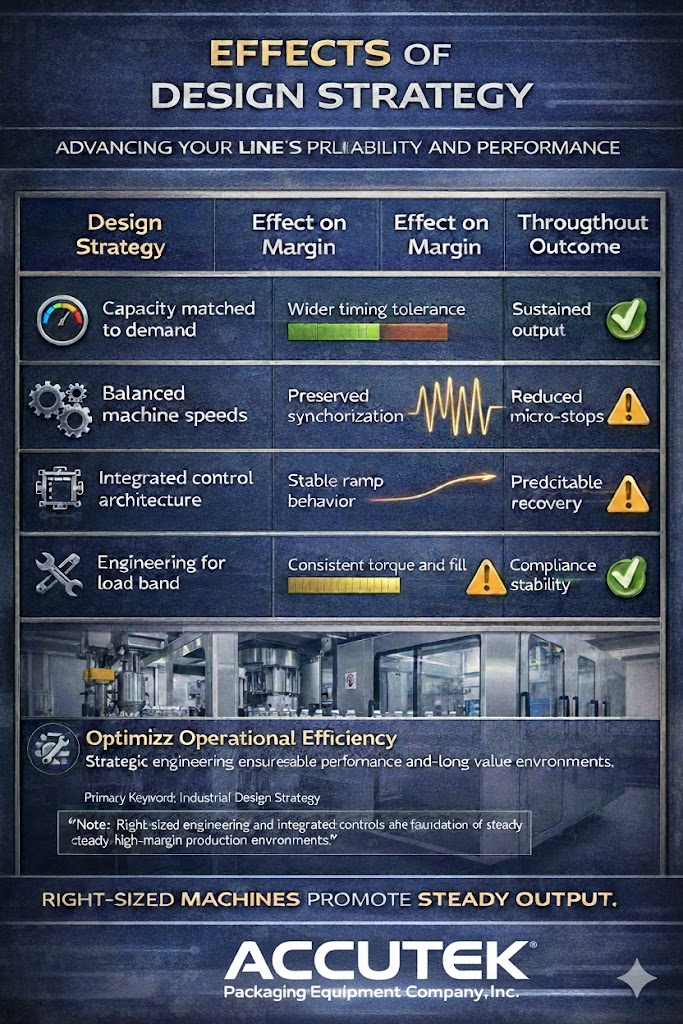
| Design Strategy | Effect on Margin | Throughput Outcome |
|---|---|---|
| Capacity matched to demand | Wider timing tolerance | Sustained output |
| Balanced machine speeds | Preserved synchronization | Reduced micro-stops |
| Integrated control architecture | Stable ramp behavior | Predictable recovery |
| Engineering for load band | Consistent torque and fill | Compliance stability |
The goal is not maximum output.
The goal is controlled output.
Why California Manufacturers Choose Accutek for Right-Sized Engineering
Accutek Packaging Equipment Company, Inc., headquartered in California, designs packaging machinery with system integration as the primary objective.
Instead of selling peak speed alone, Accutek engineers each packaging machine to operate inside a stable performance band that matches real production needs. Filling, capping, labeling, and conveying systems are designed as coordinated units, not isolated components.
This approach offers California manufacturers:
- Matched acceleration curves
- Balanced torque engagement
- Integrated control sequencing
- Scalable expansion without destabilizing the line
- Local engineering support and service
By focusing on right-sized architecture rather than maximum RPM, Accutek helps California facilities achieve sustained throughput and regulatory confidence.
Integration protects margin.
Margin protects profitability.
Explaining It Clearly
Imagine purchasing a commercial truck rated to haul 40 tons for a delivery route that requires 8.
The vehicle will function, but efficiency and control may suffer in urban conditions.
Packaging lines behave similarly.
A packaging machine designed for extreme output does not always operate optimally at moderate speed.
Right-sizing preserves rhythm.
Final Perspective
- Bigger packaging machinery does not guarantee stability.
- Operating far below design capacity can reduce mechanical consistency.
- California production environments reward predictability over peak RPM.
- Right-sized engineering preserves timing margin.
- Integrated packaging machinery protects synchronization across the line.
- Sustainable throughput comes from balanced architecture, not oversized equipment.
For more details contact us:
| California | Texas | Florida |
|---|---|---|
| Address: 2980 Scott St, Vista, CA 92081 | Address: 8051 Jetstar Dr #175, Irving, TX 75063 | Address: 14231 Jetport Loop W #1, Fort Myers, FL 33913 |
| Phone: (760) 734-4177 | Phone: (972) 915-6888 | Phone: (239) 225-4020 |
| Fax: (760) 734-4188 | Fax: (971) 915-6999 | Fax: (239) 225-4024 |
| Hours: 8:00 AM – 4:30 PM | Hours: 8:00 AM – 4:30 PM | Hours: 8:00 AM – 4:30 PM |

