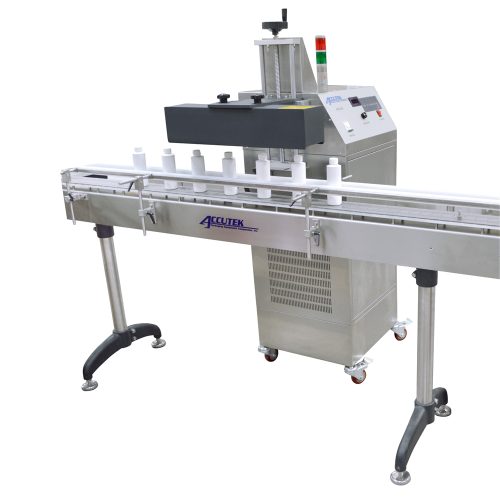
Explaining the Induction Sealing Process
Induction sealers use electromagnetic energy to bond a foil liner to the container opening. The process works as follows:
- A foil liner is inserted into the cap
- The cap is applied to the container
- The container passes under an induction coil
- An electromagnetic field heats the foil liner
- The polymer layer melts and bonds to the container
- The seal cools, forming an airtight closure
This process creates a hermetic seal that prevents leakage, oxygen entry, and contamination.
Because the heat is generated within the foil itself, the product inside the container is not directly exposed to external heat.
Induction Sealer Configurations
Induction sealing systems are available in multiple configurations depending on production scale and automation requirements.
Handheld Induction Sealers
Handheld units are designed for low-volume or flexible production environments. They may be manually operated with trigger-based sealing and feature digital controls for sealing time adjustment. They are compact and portable in design, and are ideal for R&D and small batches.
These sealers are best suited for:
- Laboratory environments
- Small production runs
- Product testing and development
Semi-Automatic Induction Sealers
Semi-automatic systems combine manual handling with automated sealing. With these, the operator positions the container, and the machine performs the sealing cycle. These sealers feature adjustable power and timing controls and can moderate production speeds.
Semi-automatic induction sealers are best for:
- Small to mid-scale manufacturing
- Flexible production setups
- Multi-product operations
Automatic Induction Sealers
Automatic systems are designed for continuous inline production. They feature conveyor-fed operation and use high-frequency electromagnetic sealing heads. Their heights and positions can be adjusted for different containers, and they have integrated cooling systems for consistent performance.
Automatic induction sealers are best suited for:
- High-speed packaging lines
- Food, pharmaceutical, and chemical industries
- Large-scale production environments
Capless & Specialized Induction Systems
Advanced systems may include:
- Capless sealing (direct foil application)
- Multi-head sealing configurations
- Custom coil designs for unique container shapes
These systems are used for specialized packaging requirements where traditional cap-based sealing is not suitable.
Core Engineering Capabilities
Induction sealers are engineered for precision, consistency, and non-contact sealing performance.
Key capabilities include:
- Electromagnetic induction heating for foil bonding
- Adjustable sealing power and exposure time
- Compatibility with various foil liner materials
- Conveyor synchronization for consistent throughput
- Minimal energy consumption compared to contact sealing
These systems are designed to:
- Create airtight, leak-proof seals
- Provide visible tamper evidence
- Extend product shelf life
- Reduce contamination risk
Induction sealing is an effective method for tamper-resistant packaging and product protection.
Best Application Fit
Induction sealing technology is essential for products requiring secure closure, freshness preservation, and tamper evidence. It is typically used for:
- Bottled beverages and liquids
- Food products (sauces, dairy, condiments)
- Pharmaceuticals and nutraceuticals
- Cosmetics and personal care products
- Chemical and industrial products
Induction sealing is widely used because it creates a hermetic barrier that protects products throughout storage and transport.
Induction Sealing System Overview
System Type
|
Primary Role
|
Production Environment
|
Key Strength
|
Typical Use Case
|
| Handheld Sealer |
Manual sealing |
Low-volume production |
Flexible and portable |
Lab and R&D |
| Semi-Automatic Sealer |
Assisted sealing |
Mid-scale production |
Adjustable and efficient |
Small manufacturing |
| Automatic Sealer |
Inline sealing |
High-speed production |
Continuous operation |
Food & pharma lines |
| Capless Induction System |
Direct foil sealing |
Specialized lines |
Unique application flexibility |
Custom packaging |
Integration Within a Packaging Line
Induction sealers are typically integrated after capping operations. A typical workflow includes:
- Container filling
- Cap application with foil liner
- Induction sealing process
- Cooling and seal formation
- Labeling and inspection
- Final packaging
Because induction sealing requires proper cap torque and timing, it is closely synchronized with capping and conveyor systems. When properly integrated, manufacturers gain:
- Consistent seal integrity
- Reduced product leakage
- Improved line efficiency
- Enhanced product safety
- Scalable production capability
Frequently Asked Questions
What is an induction sealer?
An induction sealer is a machine that uses electromagnetic energy to bond a foil liner to a container opening, creating a hermetic seal.
How does induction sealing work?
It uses an electromagnetic field to heat a foil liner inside the cap, melting a polymer layer that bonds to the container.
Why is induction sealing important?
It provides tamper evidence, prevents leaks, and extends product shelf life.
Can induction sealing be used on all containers?
An induction sealer will work best with plastic or glass containers that use caps with compatible foil liners.
Is induction sealing safe for products?
Yes. The heat is generated in the foil liner, not directly in the product, making it suitable for sensitive contents.
Consult with Packaging System Engineers
Selecting the right induction sealer requires evaluating container type, cap design, liner material, and production speed.
Accutek Packaging Equipment Company, Inc. offers induction sealing systems ranging from handheld units to fully automated inline machines, designed for reliable sealing, consistent performance, and seamless integration into modern packaging lines.
For manufacturers focused on product safety, leak prevention, and tamper-evident packaging, induction sealers provide a critical solution that ensures every container is securely sealed and ready for distribution.
Contact Accutek today to learn more about induction sealers and what they can do for your packaging line. We can also discuss the various fillers, cappers, and labelers we have under our product umbrella.
 (760) 734-4177