 (760) 734-4177


Eyeshadow, concealer, lipstick; all kinds of cosmetics take work. A lot of work. Like, enough work that you’re probably wondering, “How can I get all of this done without having to do so much?”
Machines—that’s the answer. Stainless steel-constructed, automatic, precise machines. With packaging machinery like what we offer here at Accutek, you can significantly reduce the time and effort required to fill your cosmetic containers and get them out the door and to your customer(s).
Let’s take a look at what machines are necessary for carrying out your cosmetics manufacturing process.
What Kinds of Cosmetic Packaging Machines Do You Need?
The most essential machines you would need for a cosmetics line would be a filler to pour the product into your container, a capper to apply a cap, and then a labeler to stick on your company branding.
But considering your industry and the types of products you produce, not just any one machine from each of these categories will do. You’ll need specialized machines to handle your goods. Let’s take a look at some of them.
Cosmetic Filling Machines
Piston Fillers
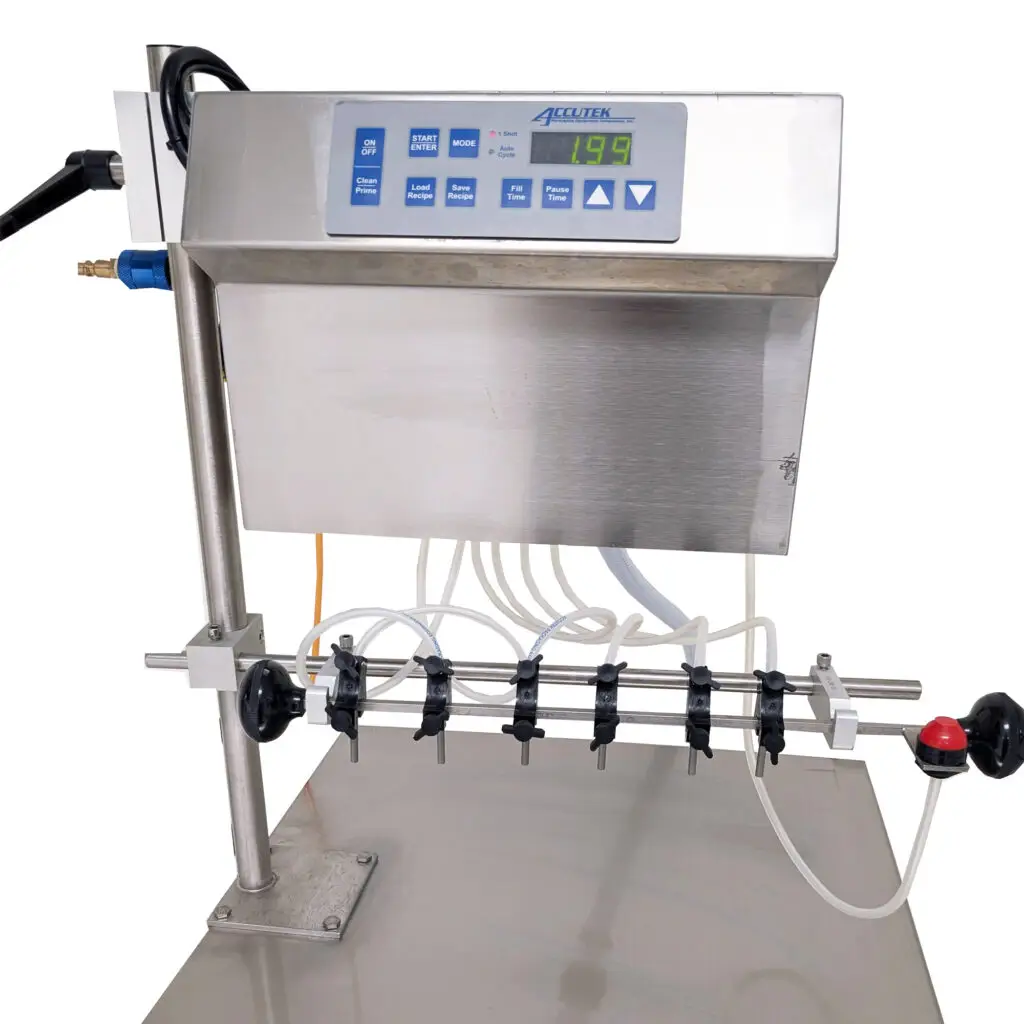
If your product is on the more viscous side, it may be difficult for some fillers to pour it out. This is why a piston filler is an optimal choice for products like shampoos and lotions. An extending piston can push product through a cylinder, forcing it through a nozzle and into a container.
Several of Accutek’s machines are piston fillers, like the Automatic Volumetric Filler (AVF) and the Semi-Automatic Volumetric Filler (SVF). However, the SVF is a semi-automatic machine that’s mostly meant to operate independently of other hardware. So an AVF is optimal for inclusion in a cosmetics bottling line.
Vacuum Fillers
But not every product is going to be as thick as shampoo. If your product is something thinner, like nail polish or perfume, then you’ll want to use a vacuum filler. These machines use vacuum pumps to draw liquid from a supply tank before depositing it into a container.
Accutek’s AccuVac can fill up to 12 bottles at a time to the same visual fill level using a drip tray and neck grabber. A diving head assembly lowers a series of fill nozzles, forming airtight seals with each bottle opening.
Cosmetic Labeling Machines
Labeling is critical, because otherwise, how would a customer know a product is yours? Or what it does? Or what ingredients it has? That’s the obvious stuff, but what about consistency? Quality? Evidence of tampering?
All these factors are important reasons as to why it’s crucial to get labeling right. But like with everything else, your product’s specifics will dictate exactly what machine is best for you.
To give a quick example, let’s say you weren’t looking to start an entire cosmetic bottling line, or maybe you have a separate cosmetic product you don’t need a whole line for right now. You just need it labeled. It’s a small perfume bottle that you can easily fill and cap with the equipment you already have on hand.
For something like that, you’d just need a semi-automatic tabletop labeler. Smaller, cheaper, but still efficient, a machine like this would have no trouble labeling your containers.
Automatic Labelers
But you’re looking for complete automation. You want to be able to take a machine and incorporate it into a line, press a button, sit back, and watch everything go.
Which is where an automatic labeler comes in. These machines can be incorporated into an already-existing production line, programmed to work in concert with the other machines, and carry out labeling tasks.
Pressure-based labelers work well for these products. Let’s look at a couple.
APS-106
Accutek’s APS-106 is an automatic wraparound labeler that’s consistent, sturdy, and efficient. It includes a mounted conveyor, easily able to handle most containers and able to apply labels up to six inches wide.
Its direct counterpart, the APS-108, carries out the same method of labeling, but can accommodate labels up to eight inches wide.
APS-206
If you’re looking for consistent, continuous production for your cosmetics line, then we recommend the APS-206. This machine is very similar to the APS-106, but it features a second labeling station. So when you run out of a label reel, the second station will pick up the slack. And while it’s labeling, you can place another reel of labels onto the first head for when the second one runs out.
Cosmetic Sleeving Machines
Sleeving machines apply shrink sleeves or tamper-evident bands onto containers before applying heat, sometimes with a heat tunnel. Unlike pressure-sensitive labeling machines, like the APS line, sleeving provides full-container coverage and conforms to complex shapes.
So if you have a bottle that’s wavy, curly, or looks like a pineapple, a sleever’s what you want. Specifically, Accutek’s SL line.
SL1-150 Compact Sleeving System
The SL1-150 is designed for efficient, space-saving production. It has a compact footprint for limited space and can achieve speeds up to ~150 containers per minute in ideal conditions. It has user-friendly controls for easy operation and is suitable for a wide range of container sizes.
SL1-350 Extended Layflat System
The SL1-350 is designed for larger sleeve formats. It handles larger layflat labels and maintains accuracy and efficiency. It’s best for larger cosmetic bottles, like shampoo and conditioner.
SL2-200 High-Speed Sleeving System
The SL2-200 is engineered for high-speed, precision sleeving. It can handle sleeves up to 200mm layflat and features servo-driven film delivery for superior accuracy. It’s fast and can run on a continuous basis.
A Cosmetic Bottling Journey from Start to Finish
An entire packaging line for cosmetics would likely include at least some combination of the following machines, not necessarily in this order:
- Turntables
- Conveyors
- A filler
- A capper
- A labeler
- An elevator
- A bottle orienter
- And possibly more, depending on your needs
Let’s assume, again, that you sell shampoo. You’ve got your product in the reservoir for the filling machine, and the plastic bottles are ready to go. So here’s how the entire process would work. You dump as many bottles as you can into a bulk elevator/loader, which deposits them into the orienter’s bowl. The bottles exit onto a conveyor belt, where the orienter flips them into an upright position until you have several upright bottles in sequence.
A sensor installed on the piston filler detects when enough bottles are present and opens a gate to allow several through. These bottles stop beneath the nozzles, which lower to fill the bottles with shampoo, retracting as they finish. The now-full bottles continue to the capping stage, where they pass beneath a spindle capper. A cap is deployed from a slide onto the neck of each bottle before being tightened on by a series of spindles.
Now the labels move on to the wrapper. A foam or rubber-like spacing wheel slows and makes sure that there is enough space between each bottle for proper labeling. The bottle catches a flagging end of a label, pulling it along as it passes. A foam roller rotates the bottle, and a pad on the opposite side presses up against it, adhering the label to the bottle.
Your bottle’s journey is not over at this point, oh no. It still needs to be shipped! So it moves on to a case packer, which collects even more bottles to wrap in one large package. And now your product is ready to be shipped to retailers for sale!
Now, not every packaging line is going to be the same. For instance, instead of buying an elevator and an orienter, you could just get a turntable and place bottles onto it manually before they’re deployed to the filler. Or you could add a checking machine that makes sure your bottles weigh the proper amount, have their labels on correctly, et cetera.
Overview of Automatic Machines for a Cosmetic Bottling Line
| System Type | Primary Role | Production Environment | Key Strength | Typical Use Case |
| AVF | Filling | Automated inline production | Multi-head higher-speed filling | Higher-volume packaging lines |
| APS-106 | Pressure-sensitive labeling | Flexible inline systems | Adjustable labeling | Multi‑product operations |
| APS-108 | Pressure-sensitive labeling | Flexible inline systems | Adjustable labeling of larger labels | Multi‑product operations |
| APS-206 | Pressure-sensitive labeling | Flexible inline systems | Continuous labeling | Multi‑product operations |
| SL1-150 | Compact sleeving | Small to mid-scale | Space-efficient design | Flexible packaging lines |
| SL1-350 | Large layflat handling | Mid-scale production | Handles larger labels | Large container packaging |
| SL2-200 | High-speed sleeving | Automated lines | Precision and throughput | Consumer goods |
Frequently Asked Questions About Packaging Solutions for Cosmetic Products
Is putting together an automatic line more expensive than using several semi-automatic machines?
While we can’t put an exact figure on it, generally, yes. This is because the automatic machines are generally larger and more complex than their semi-automatic counterparts. But on the flipside, they are powerful, efficient, and fast, and they can be put together in a single automatic line for superior efficiency.
Are sleevers better than pressure-sensitive labelers?
Not necessarily; both have their purposes. The main reason you’d want to get a sleeving machine is if your cosmetics have an unconventional bottle design, and if you want to provide evidence of product tampering to your customers.
Are these machines easy to clean?
These machines are generally easy to clean, yes. Some may require additional equipment for cleaning, like a clean-in-place system or a conveyor bath. A CIP system allows you to clean filling machines, like the AVF, without having to disassemble anything.
Want to Learn More?
If you’re looking to take a deeper look into packaging machines and how they can improve your cosmetics production, then look no further than Accutek Packaging. Along with the machines we’ve already discussed, we have even more that can fulfill your needs for cosmetics production.
Feel free to contact us today or browse around our newly refurbished website to check out our catalog of machines, their specifications, and their many capabilities.
